
Technological advancement is essential for a nation’s growth, but true development must consider its impact on employment and livelihoods. From UPI to electric vehicles, India has witnessed innovations that have transformed everyday life. However, technologies such as fully autonomous, driverless cars raise an important question: Can a country achieve meaningful progress if millions of people risk losing their ability to earn a living? This article explores the importance of balancing innovation with employment, human dignity, development that protects livelihoods and inclusive economic growth.
Development Should Move Forward Without Leaving Livelihoods Behind
Development is necessary for every nation. New technologies improve convenience, increase productivity, reduce costs and open doors to opportunities that were once unimaginable. However, development should not be measured solely by how advanced a country becomes. It should also be measured by how effectively that progress improves people’s lives.
India is a country where millions of people depend on their daily earnings to support their families. For many, employment is not simply a career choice; it is their primary means of survival.
Therefore, when introducing a new technology, an important question must be asked:
Does this technology help people improve their lives, or does it take away their ability to earn a living without providing a realistic alternative?
This question should be at the heart of every discussion about technological progress.
Understanding Development That Protects Livelihoods
Not all technological advancements affect employment in the same way.
Some technologies change how people perform their jobs, while others have the potential to eliminate the need for certain jobs altogether.
Understanding this distinction is essential when deciding how new technologies should be introduced into society.
UPI: Making Payments Easier Without Eliminating the Need for Businesses
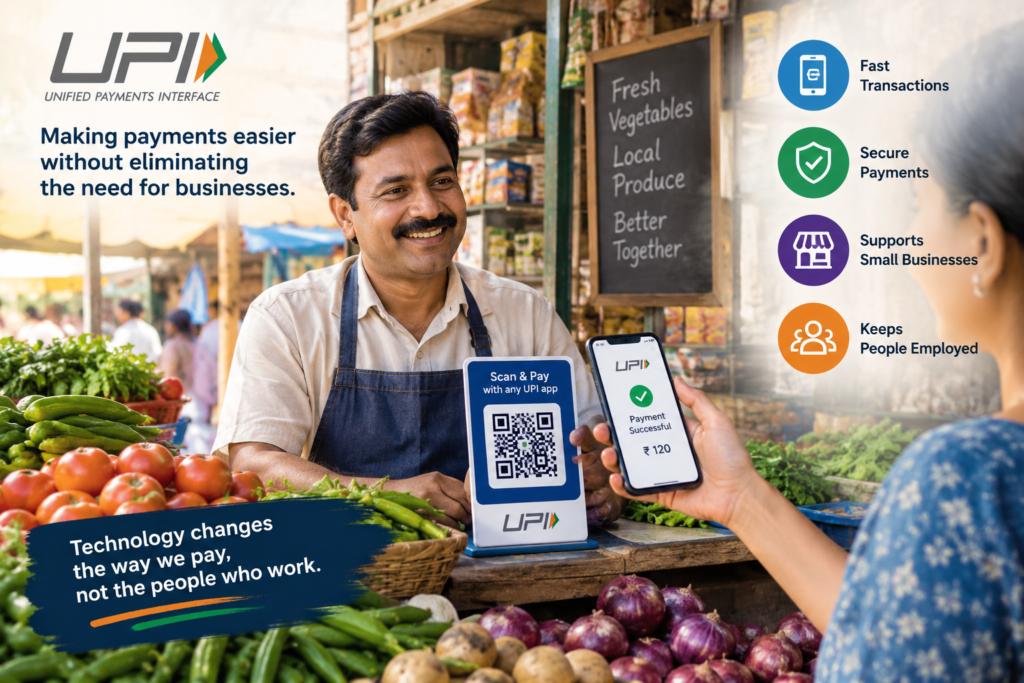 Development that protects livelihoods through UPI digital payments at an Indian vegetable stall.
The introduction of the Unified Payments Interface (UPI) transformed the way Indians make payments. People can now transfer money, pay shopkeepers and complete transactions within seconds.
However, UPI did not inherently eliminate the need for shopkeepers, street vendors, small businesses or customers. Instead, it provided an additional way to conduct transactions.
A vegetable vendor can accept digital payments. A small shop owner can receive money without needing to handle cash for every purchase. Customers can make payments conveniently without carrying physical currency.
UPI changed the payment process while allowing millions of people to continue their existing occupations.
Although digital payments have affected some traditional payment-related activities and created new challenges, the technology illustrates how innovation can improve existing systems without requiring the widespread replacement of the people who use them.
Electric Vehicles: Changing the Technology While Preserving the Driver’s Role
Electric vehicles offer another useful example.
Consider a taxi driver who previously operated a petrol or diesel car. When switching to an electric vehicle, the driver can continue transporting passengers and earning an income.
The vehicle’s power source changes, but the essential service remains the same.
Similarly, an auto-rickshaw driver can adopt an electric auto-rickshaw, and a delivery worker can use an electric scooter.
Of course, the transition to electric mobility can affect certain manufacturing jobs, fuel-related businesses and vehicle maintenance activities. Nevertheless, electric vehicles do not inherently remove the need for a human driver.
This illustrates an important form of technological progress: changing the tools people use without automatically removing the work through which they support themselves.
Driverless Cars and the Challenge of Protecting Livelihoods.
Fully autonomous vehicles introduce a different challenge.
Unlike conventional electric vehicles, which still require someone to drive them, fully autonomous vehicles are designed to operate without a human driver performing the driving task.
Imagine a taxi driver who has spent 15 or 20 years earning a living by transporting passengers. Driving may be the only occupation he knows, and his daily income may support his children’s education, household expenses and other family responsibilities.
Now imagine autonomous taxis becoming widespread.
If transport companies can operate vehicles without employing drivers, some human-driven taxi services could face reduced demand. Depending on the scale of adoption, many drivers could experience income losses or displacement.
The consequences would extend beyond the drivers themselves. Their families, local businesses and communities could also feel the impact.
Development That Protects Livelihoods in India : Not Everyone Can Easily Learn a New Profession
One common argument in favour of automation is that workers who lose their jobs can learn new skills.
In theory, this sounds reasonable. In practice, the transition can be much more difficult.
Some drivers have limited formal education. Others may lack access to computers, training centres, financial resources or the time needed to learn a different profession.
A person who has spent decades driving a taxi cannot automatically become a software developer, robotics technician or artificial intelligence specialist.
Even when new jobs are created, they may require qualifications, experience or technical skills that displaced workers do not possess.
Therefore, creating new employment opportunities does not automatically compensate for the jobs lost.
A fair development strategy must consider whether the people affected by technological change can realistically access the new opportunities it creates.
Employment Is More Than a Source of Income
For many people, employment provides more than money. It offers independence, dignity, stability and a sense of purpose.
When someone loses a livelihood, the consequences may include debt, financial insecurity, family stress and reduced access to education or healthcare.
These consequences are especially serious for people who have limited savings and depend on daily earnings.
Technological progress should recognise these human realities instead of treating workers as numbers in an economic calculation.
Should India Reject Technological Development?
Protecting employment does not mean rejecting innovation.
Driverless technology could potentially offer benefits, including improved mobility for some passengers, greater convenience and reductions in certain types of road accidents if the systems prove safer under real-world conditions.
It may also create new employment opportunities in vehicle maintenance, fleet operations, software, infrastructure and safety systems.
However, these potential benefits must be weighed against the risks, including job displacement, road safety, cybersecurity, accountability and the cost of deploying the technology.
The question is not whether India should develop technologically. The question is how that development should take place.
Introduce Technologies Responsibly
Before introducing a technology that could significantly affect employment, policymakers and businesses should evaluate its likely consequences.
This could include assessing how many jobs might be affected, which communities are most vulnerable, whether new employment opportunities are accessible and what protections would be needed.
Controlled trials and gradual implementation can help identify problems before a technology becomes widespread.
Where the risks to livelihoods are substantial and adequate protections are not yet available, delaying broader deployment may be justified.
Protect Workers Before Replacing Their Jobs
If a technology is expected to replace a large number of workers, practical measures should be developed before widespread adoption.
These could include:
- Accessible vocational training for affected workers.
- Financial assistance during periods of transition.
- Opportunities to move into related occupations, such as fleet supervision, vehicle servicing or transport operations.
- Support for small business owners who may be affected by automation.
- Reasonable timelines that allow workers and businesses to prepare for change.
Such measures should be realistic, affordable and accessible to the people who need them most.
A promise that workers can simply learn new skills is not enough. The opportunities must genuinely exist.
A Better Model for Development That Protects Livelihoods
India needs innovation to remain competitive, improve productivity and raise living standards. At the same time, it must consider the economic realities of its large and diverse workforce.
A balanced development strategy should follow several principles.
Prioritise Human Well-Being
The success of a new technology should be evaluated not only by its efficiency or profitability but also by its effect on people’s quality of life.
Improve Existing Occupations Wherever Possible
Technologies that help workers perform their jobs more safely, efficiently and profitably can deliver significant benefits. Examples include digital payment systems, improved vehicle technology and tools that help small businesses reach more customers.
Evaluate Job Displacement Before Large-Scale Adoption
When a technology could eliminate an occupation, its employment consequences should be assessed before it is widely deployed.
Make Transitions Fair and Practical
If job replacement becomes unavoidable, affected workers should have a realistic path towards alternative employment. Training must match actual job opportunities rather than simply teaching skills with no clear employment prospects.
Measure Progress by Its Benefits to Society
A technologically advanced country should also strive to provide economic security, opportunity and dignity to its citizens.
Innovation and employment protection should not always be treated as opposing goals. With careful planning, investment and appropriate safeguards, a country can pursue both.
Development That Protects Livelihoods: The Real Meaning of Progress
Imagine two countries.
The first adopts every new technology as quickly as possible, even when large numbers of people lose their livelihoods and have no realistic alternatives.
The second carefully evaluates new technologies, encourages innovation, protects vulnerable workers and prepares people for changes in the economy.
Both countries may become technologically advanced. However, the second approach places greater emphasis on ensuring that progress benefits society as a whole.
This does not mean every existing job must be preserved forever. Economies naturally change, and some occupations become less necessary over time.
It means that the human consequences of those changes should be taken seriously.
A country should not measure its success only by the technologies it possesses. It should also consider how well its people can live, work and prosper in the society those technologies create.
Development That Protects Livelihoods: A Better Future for India
Development that protects livelihoods is essential for building a strong and sustainable economy. In a country like India, development that protects livelihoods ensures that technological progress does not leave vulnerable workers behind. By prioritising development that protects livelihoods, we can encourage innovation while preserving employment opportunities for millions of people. The idea of development that protects livelihoods highlights the importance of balancing modern technology with human needs. Through development that protects livelihoods, businesses can grow while workers receive opportunities to adapt to changing industries. Ultimately, development that protects livelihoods should be a priority when introducing technologies that could replace existing jobs. A future built on development that protects livelihoods can create a more inclusive society where economic progress benefits everyone.
Let Technology Advance, but Let People Advance With It
Development is essential, but development without consideration for livelihoods can create serious social and economic challenges.
UPI demonstrated how technology can make everyday transactions easier while supporting existing businesses. Electric vehicles show how an industry can change its technology while allowing many workers to continue performing their jobs. Fully autonomous vehicles raise a more difficult question because they have the potential to remove the human driver from the driving task itself.
The appropriate response is not to fear every new invention, nor is it to welcome every technology without examining its consequences. It is to make thoughtful decisions based on safety, economic benefits, employment risks and the needs of ordinary people.
Where a technology threatens livelihoods on a large scale, restrictions, gradual adoption or temporary delays may be reasonable until adequate safeguards and alternatives are in place.
Ultimately, the purpose of development should not be merely to create a more technologically advanced country. It should be to create a better country for the people who live in it.
A truly developed nation is not one in which machines can do everything. It is one in which technological progress helps people live with greater security, dignity and opportunity.
Let technology move forward. Let innovation flourish. But let no vision of progress forget the people it is supposed to serve.
FOR MORE INFO CLICK HERE